
← Start with Part 1: Course Drift
Part 6 of Navigation & Drift
When Adaptation Becomes Drift
Adaptive execution while preserving strategic direction.
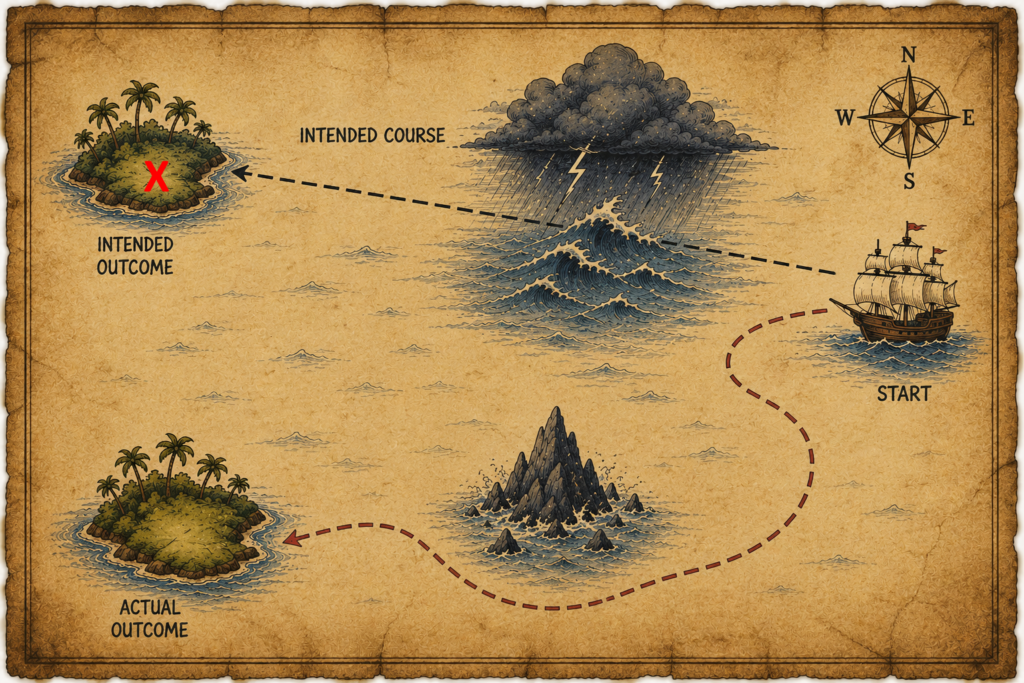
I’ve seen biotech teams mistake changing conditions for a reason to continually redefine direction. Sometimes adaptation is necessary – markets shift, funding environments change, and technical assumptions fail.
Good captains adjust to weather, but resilient organizations still maintain a coherent strategic direction.
I worked with one company that faced a series of external and technical shifts over several years.
Each pivot made sense in context. Market conditions changed. Economics changed. Technical realities evolved. And new opportunities emerged.
The organization adapted repeatedly – first by changing product strategy, then platform focus, and eventually the underlying assumptions about feedstocks, processes, strains, products, and commercialization pathways.
None of these decisions were irrational on their own. But the cumulative effect was much harder to reconcile.
Over time, nearly every foundational element of the company had shifted. Eventually, investors started asking a different kind of question:
“How did the company end up here?”
Internally, the questions started sounding different too:
“What are we actually trying to build?”
“Why are we doing this?”
Leadership teams often miss these signals because each individual decision still feels rational in the moment.
That’s when I realized adaptation alone is not strategy.
Resilient organizations evolve. They adjust to changing conditions. They refine tactics and reassess assumptions.
But they also preserve a coherent strategic direction that ties those adaptations together.
Otherwise, adaptation itself can become a form of drift.
Next in Navigation & Drift →
Complementary Intelligences