
Build vs. Buy Isn’t the Only Choice
Originally published on LinkedIn, June 15, 2026
One of the classic project management decisions is build versus buy. Do you develop a capability internally, or outsource it to someone else? The answer often comes down to the same tradeoffs: cost, time, and quality. It’s the Iron Triangle.
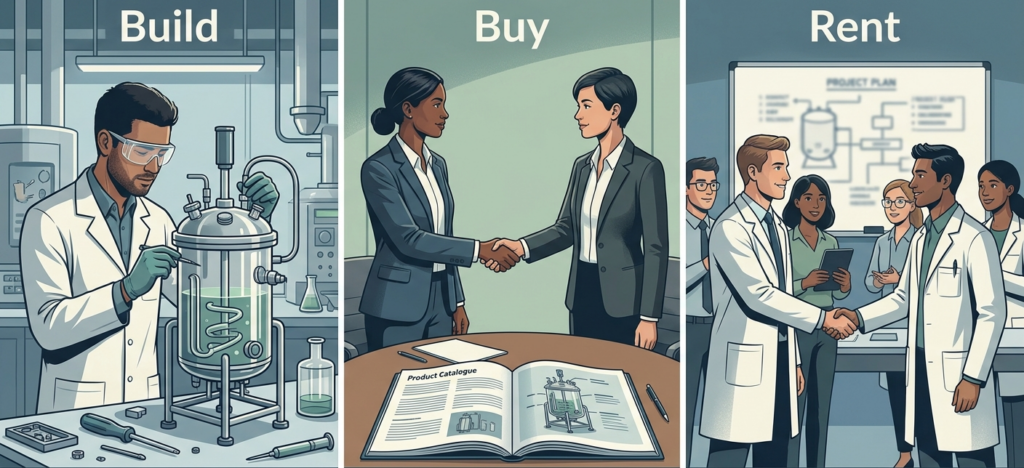
In my career, I have often been faced with the decision to build or buy. At Dow AgroSciences, we launched a new project to make a biosurfactant. Growing the organism required a specialized bioreactor. We built it ourselves. We had the required expertise and capabilities. It worked. We could have contracted out but that likely would have cost more and might have taken longer. Because building it internally, we did not have to rely on emails and weekly meetings. It was an Agile project.
At Curative, we did not have the capability to make lyobeads of our diagnostic reagents. So we contracted out to a CDMO. We did not have the necessary physical equipment nor the deep expertise.
For much of my career, those were the choices.
Build. Or buy.
But increasingly – especially in a tighter capital environment – biotech companies have a third option:
Rent.
I have found myself recommending this approach more often in recent years. In one recent discussion, a client was weighing whether to purchase new or used bioreactors outright. Leasing had not even been part of the original conversation. Once it became an option, the tradeoffs changed.
Not just equipment, but capabilities as well. Bioreactors can be leased instead of purchased outright. Cleanroom space can be rented in centralized facilities. Fractional engineers, quality specialists, and bench scientists can be brought in exactly when they’re needed.
Ownership is no longer binary.
Instead of asking whether a capability belongs inside or outside the organization, companies can now ask a different question:
How do we assemble the right combination of ownership, outsourcing, and borrowed expertise to get to the next inflection point?
Cost, time, and quality still matter.
The Iron Triangle hasn’t changed.
How we make tradeoffs within it has.