
I’d Switch to Alternative Meat Tomorrow. Here’s What Still Has to Change
Originally published on LinkedIn, February 5, 2026
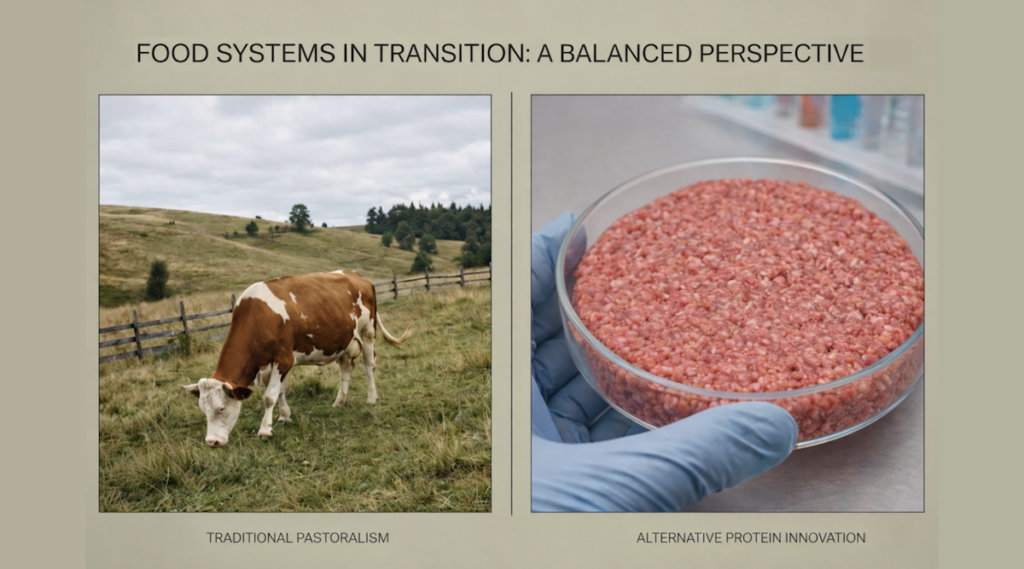
I recently read an excerpt from Paul Friedrich’s new book Meat, which compares alternative proteins to electric vehicles – the idea being that once a better technology exists, the old constraint (animals, like combustion engines) simply becomes unnecessary.
It’s a compelling analogy. And in principle, I agree.
I would absolutely shift to alternative meat products if they were more widely available, affordable, and tasted good.
But that qualifier matters more than it often gets credit for.
Not all “alternative proteins” are the same
One thing that gets lost in this conversation is how different plant-based and cultured meat actually are.
I’m far less inclined to adopt many plant-based “meat” products, not because I’m opposed to reducing animal agriculture, but because a meaningful number of these products solve one problem by introducing another – ingredient lists that are hard to reconcile with health, nutrition, or long-term consumer trust.
Cultured meat is different. At least in theory, it aims to produce the same biological product without the animal. That distinction matters.
Lumping all alternative proteins together obscures where real consumer adoption is likely to come from.
“Ultra-processed” isn’t the right question
A lot of the criticism of alternative proteins hinges on the idea of “ultra-processing.” I don’t find that framing particularly useful.
Processing itself isn’t a problem. But “ultra-processed” has become a vague, overused label that often obscures more than it clarifies.
The real questions are:
- What kind of processing is happening?
- What inputs are being used?
- What risks are being introduced or removed?
- What tradeoffs are we actually making?
Fermentation, cell culture, purification, pasteurization – these are tools. Whether they produce something better or worse depends entirely on how they’re applied.
If we want an honest conversation about food systems, we need to move past vague labels and focus on outcomes.
The question we don’t like to ask
There’s another issue that gets far less attention, and it’s the one I find myself thinking about most.
If we succeed in displacing or replacing animal agriculture at scale, what happens to the animals?
Pigs, and perhaps chickens, could plausibly survive without constant human husbandry. Cows are a different story. Modern cattle exist largely because we breed, manage, and economically justify them.
If we no longer need cows for meat and milk, do they simply… disappear?
It’s an uncomfortable question, but an important one. Transforming a system doesn’t just change production – it changes ecosystems, economies, and species-level outcomes.
Acknowledging that complexity doesn’t mean we stop innovating. It means we stop pretending the transition is simple.
Innovation isn’t a belief system
The reason global meat consumption keeps rising isn’t because people don’t care about the environment, animal welfare, or health. It’s because food choices are governed by availability, cost, taste, and habit – in that order.
Innovation doesn’t win because it’s morally compelling. It wins when technology, economics, and behavior align.
The challenge with alternative proteins isn’t belief or intent. It’s the difficulty of delivering at scale on cost, taste, and availability.
And that’s where the conversation needs to shift – away from analogies and aspirations, and toward the unglamorous work of building products that actually fit into how people live, eat, and decide.
I’m optimistic about where this is headed. But optimism without realism doesn’t change systems.
Execution does.